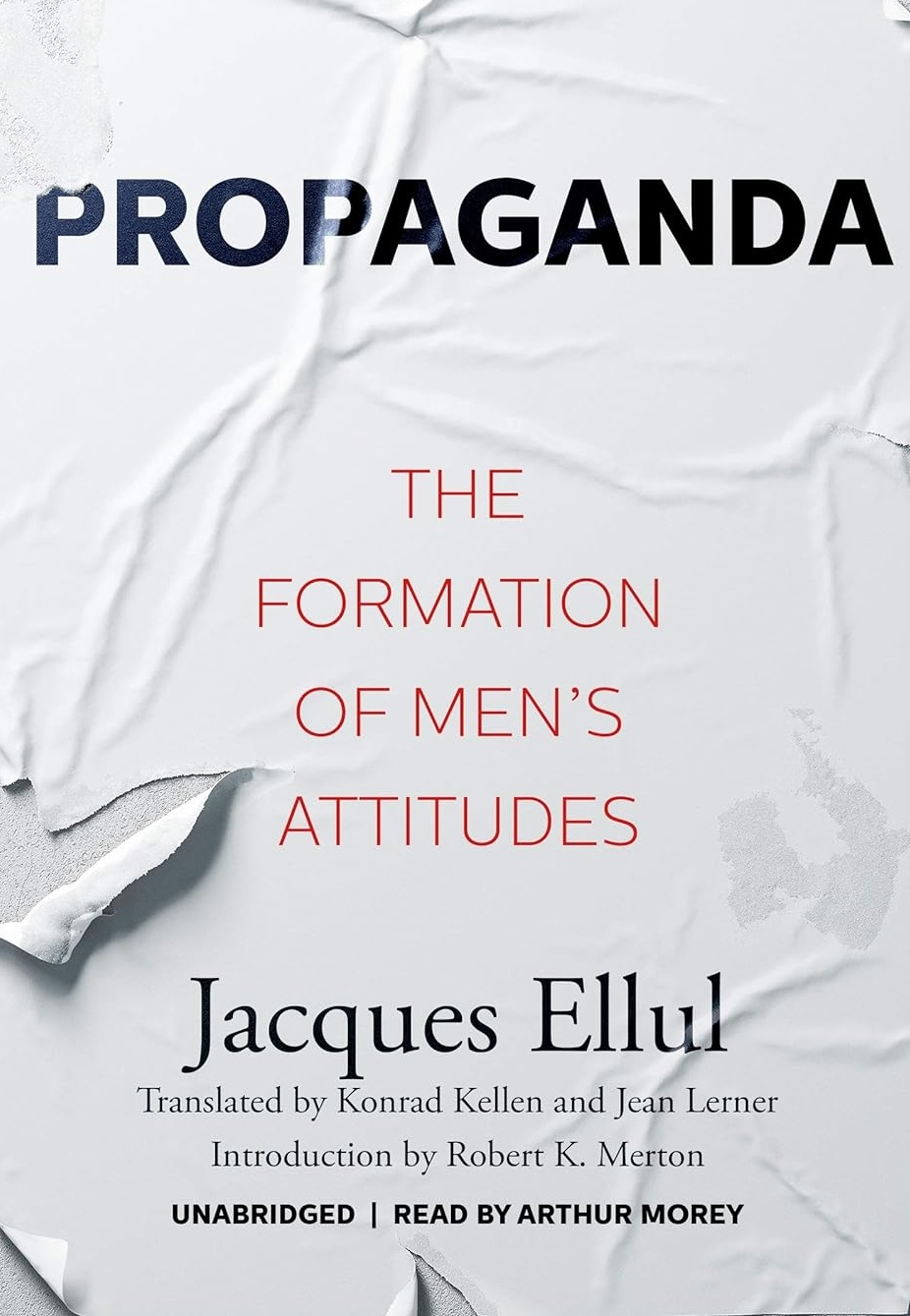
Jacques Ellul's view of propaganda and his approach to the study of propaganda are new. The principle difference between his thought edifice and most other literature on propaganda is that Ellul regards propaganda as a sociological phenomenon rather than as something made by certain people for certain purposes. Propaganda exists and thrives; it is the Siamese twin of our technological society. Only in the technological society can there be anything of the type and order of magnitude of modern propaganda, which is with us forever; and only with the all-pervading effects that flow from propaganda can the technological society hold itself together and further expand.
replies (0)A propagada of terror seeks to produce a depressing effect on the opponent and leads him to adopt a fatalistic attitude.
replies (1)At this point, we shall lay aside the observable dissociations in the propagandee between public opinion and his personal opinion; we have already said that propaganda produces a deep separation between the two. Instead we shall stress the dissociation between thought and action, which seems to us one of the most disturbing facts of our time. Nowadays, man acts without thinking, and in turn his thought can no longer be translated into action. Thinking has become a superfluous exercise, without reference to reality; it is purely internal, without compelling force, more or less a game. It is literature's domain; and I am not referring solely to "intellectual" thought, but to all thought, whether it concerns work or politics or family life. In sum, thought and reflection have been rendered thoroughly pointless by the circumstances in which modern man lives and acts. He does not need to think in order to act; his action is determined by the techniques he uses and by the sociological conditions. He acts without really wanting to, without ever reflecting on the meaning of or reason for his actions. This situation is the result of the whole evolution of our society. The schools, the press, and social pragmatism are just as responsible for this as psychotechnics, the modern political structure, and the obsession with productivity. But the two decisive factors are the mechanization of work and propaganda. The mechanization of work is based entirely on dissociation: those who think, establish the schedules, or set the norms, never act-and those who act must do so according to rules, patterns, and plans imposed on them from outside. Above all, they must not reflect on their actions. They cannot do so anyhow, because of the speed with which they work. The modern ideal appears to be a reduction of action to complete automatism. This is considered to be a great benefit to the worker, who can dream or think of "other things" while working. But this dissociation, which lasts eight hours a day, must necessarily affect all the rest of his behavior. The other element that plays a decisive role in this connection is propaganda. Remember that propaganda seeks to induce action, adherence, and participation-with as little thought as possible.?' According to propaganda, it is useless, even harmful for man to think; thinking prevents him from acting with the required righteousness and simplicity. Action must come directly from the depths of the unconscious; it must release tension, become & reflex. This presumes that thought unfolds on an entirely unreal level, that it never engages in political decisions. And this is in fact so. No political thought that is at all coherent or distinct can possibly be applied. What man thinks either is totally...
replies (0)One aspect of privatization propaganda by the State seems to us even more important: when it creates a situation in which the State has a free hand because the citizenry is totally uninterested in political matters. One of the most remarkable weapons of the authoritarian State is propaganda that neutralizes and paralyzes its opponents (or all of public opinion) by reiterating a simple set of "truths" such as that the exercise of political power is very complex, and must therefore be left to to professional politicians.
replies (0)At the same time, interpersonal communications cease. In a propagandized milieu, communications no longer take place in interpersonal patterns, but in patterns set by the propaganda organization. There is action, but no interaction. As I have shown, the propagandee and the non-propagandee cannot discuss: no psychologically acceptable communication or exchange is possible between them. Finally, in large societies in which propaganda is at work, opinion can no longer form itself except via the centralized media of information.
The stuff about small groups is great.
Let's tie that into this modern thing about the "death of the third place"
Meaning the assassination of the small groups by habitat destruction.
replies (0)replies (0)Propaganda plunges the individual in to the immediate present, taking from him all mastery of his life and all sense of the duration or continuity of any action or thought. Thus the propagandee becomes a man without a past and without a future, a man who receives from propaganda his portion of thought and action for the day; his discontinuous personality must be given continuity from the outside, and this makes the need for propaganda very strong. When the propagandee ceases to receive his propaganda, he experiences the feeling of being cut off from his own past and of facing a completely unpredictable future, of being separated from the world he lives in.
⎄ era stable
⎄ cosine similarity lock text similarity measure
⎄ cryptocryptics False
cipherlink 2f54dda484a3894e16af335db06b89e10dc21e6a03d9e0f988f003d5b6fadb8b